In Iran, Pezeshkian will be the scapegoat for the failed MoU
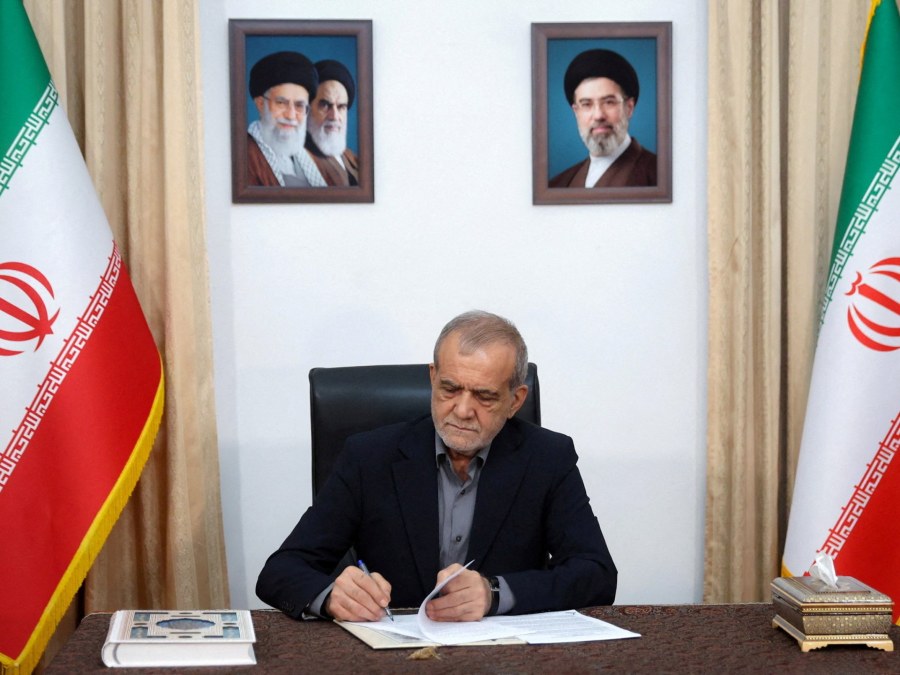
Over the past few days, the US-Israeli war on Iran has seen yet another escalation that threatens to derail peace talks. Strikes by the United States on Iran have killed at least 18 people and injured dozens. The fate of the memorandum of understanding (MoU), which the US and Iran signed as a framework for peace talks, is now increasingly under question. As anger grows among the regime’s own base, official rhetoric is increasingly pointing to one individual responsible for the perceived failure: President Masoud Pezeshkian. Blaming the president is not only an attempt to offer the Iranian public a scapegoat but also to cover up internal divisions within the ruling elite.
The architecture of a blame game Days after the MoU was signed, Supreme Leader Mojtaba Khamenei offered his first public statement on the deal. In it, he wrote that he had “a different view” on the agreement. He had permitted it only because the president, “as head of the Supreme National Security Council”, had made a commitment to safeguard the rights of the Iranian nation and the “Resistance Front” and had “explicitly accepted responsibility for it”.
Importantly, the statement did not name the man who actually negotiated the deal. Mohammad Bagher Ghalibaf, the speaker of parliament and head of the negotiating team, appears nowhere in the text even though Foreign Minister Abbas Araghchi told Iranian media that “responsibility for the negotiations was entrusted by the ‘nezam’ [the system] to Mr Ghalibaf”. Thus, the only official the supreme leader holds responsible for the most consequential agreement in the Islamic Republic’s recent history is the one who did not run it.
The omission of Ghalibaf’s name is not an oversight. It is by design. In Tehran, potential benefits and potential risks of the deal have been deliberately separated. If the MoU delivers, the triumph will belong to Ghalibaf; if it fails, the failure will be blamed on Pezeshkian. This says a lot about where power lies in post-war Iran.
Fractures in Iran’s real ruling bloc The MoU was engineered by Iran’s true ruling bloc: what I have elsewhere called the military-bonyad complex. This network fuses the Islamic Revolutionary Guard Corps (IRGC) and state security forces with sprawling revolutionary-religious foundations (bonyads) such as the Mostazafan Foundation, Setad and the Imam Reza Shrine Foundation. Built on asset transfers that masqueraded as privatisation in the 2000s and supercharged by shadow-finance networks that served as umbrella organisations for countless front companies, the military-bonyad complex is the engine behind Iran’s economic and strategic decision-making.