Editor's Pick
How Hafez al-Assad Opened Lebanon's Doors to Tehran
In the aftermath of the Iranian Revolution's triumph on February 11, 1979, two pivotal images emerged from Tehran that would foreshadow the region's turbulent future and Iran's expanding influence, culminating in the recent 'Sinwar's Deluge'. These images are critical to understanding the geopolitical shifts that have since unfolded.
The first image captures a historic meeting between two revolutionary figures whose legacies have indelibly shaped Middle Eastern politics. Ayatollah Khomeini, the architect of the Iranian Revolution, sits alongside Yasser Arafat, the leader of the modern Palestinian revolutionary movement. Their convergence symbolized a burgeoning alliance between Iranian and Palestinian causes, which would later manifest in Tehran's support for various militant groups in the region. Among those standing near Arafat are notable figures such as Lebanese cleric Sayyed Hani Fahs, Iranian cleric Sadegh Khalkhali, and Ahmad Khomeini, the son of Iran's Supreme Leader.
In the second image, Mahmoud Abbas, now the President of the Palestinian Authority, and Hani Hassan, a central committee member of the Fatah movement and the first Palestinian ambassador to revolutionary Iran, are seen standing near Khomeini. This image underscores the early diplomatic ties forged between the nascent Islamic Republic and Palestinian leadership, setting the stage for Iran's strategic involvement in Lebanon and its support for Hezbollah, a key player in the region's complex political landscape.
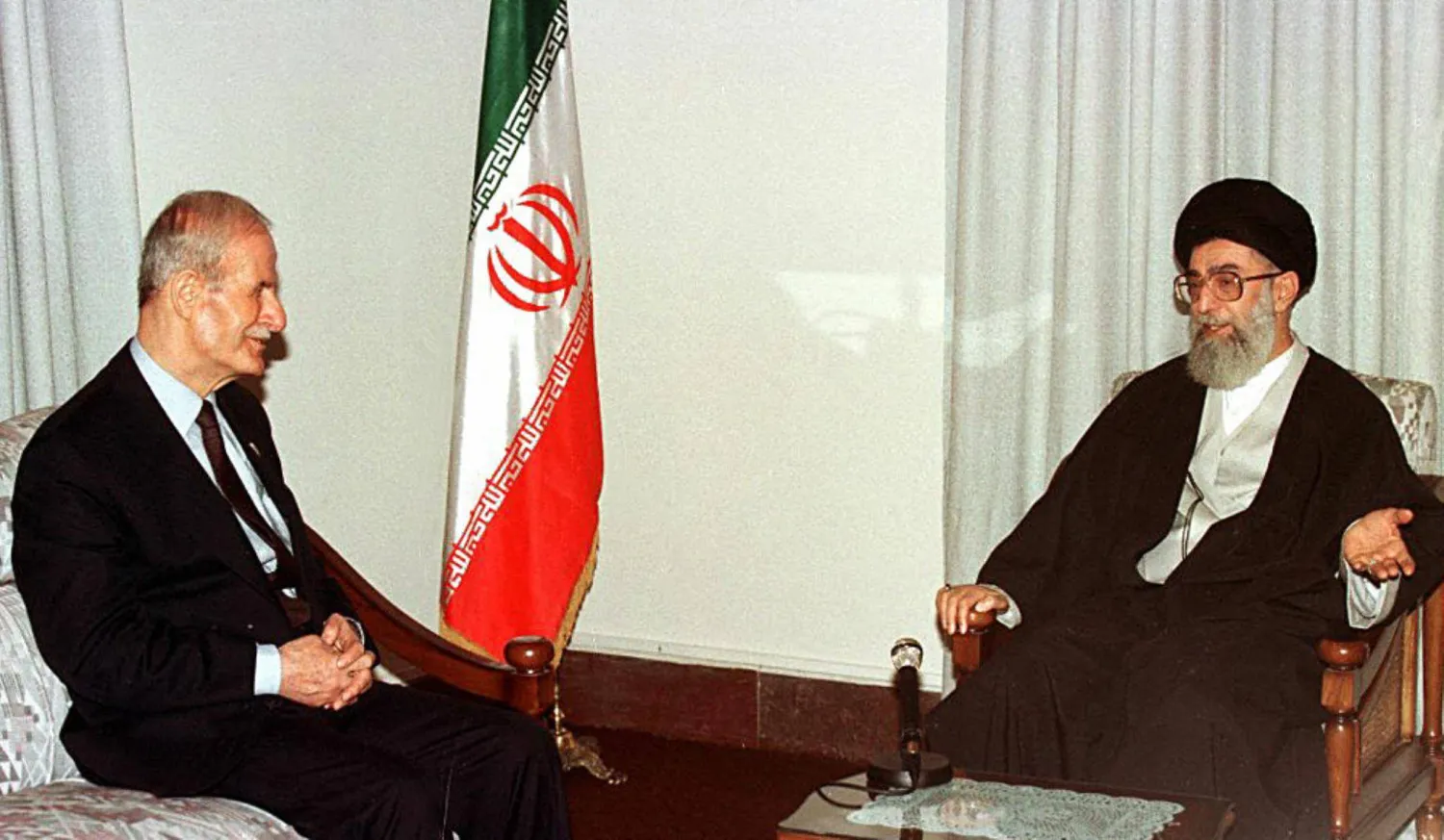
The strategic decision by Syria's Hafez al-Assad to facilitate Iran's entry into Lebanon was a calculated move that reshaped the geopolitical dynamics of the Middle East. By allowing Iran to establish a foothold in Lebanon, Assad not only strengthened his alliance with Tehran but also countered Israeli and Western influence in the region. This alliance has had long-lasting implications, contributing to the entrenchment of Iranian influence in Lebanon and the broader Levant, and remains a cornerstone of Iran's regional strategy to this day.
Part of:
The Iran File